The quenched variational principle and homogenization of limit shapes
In my latest article with my student Younghak Kwon and Martin Tassy (now at Dartmouth) we study homogenization of limit shapes.
We consider graph homomorphisms from a subset of the m-dimensional lattice to the integers, also called height functions. When the geometry and the boundary data is chosen carefully, one observes a limit shape when picking an arbitrary height function uniformly at random:
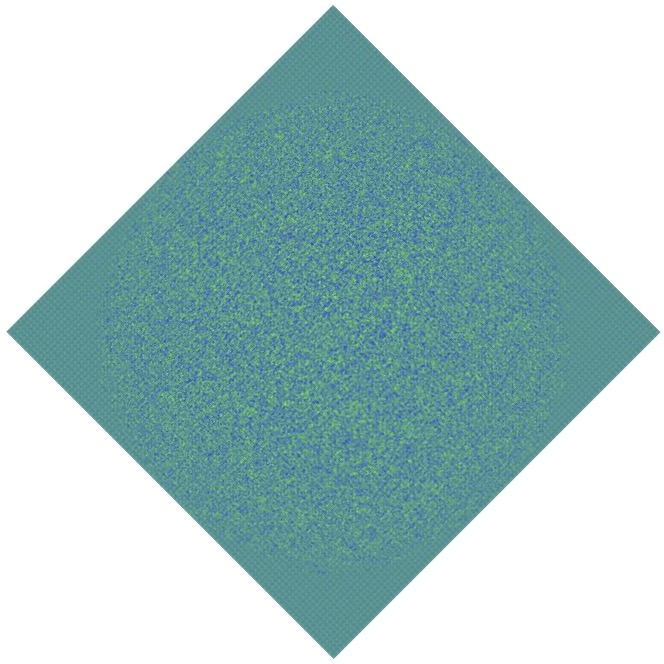
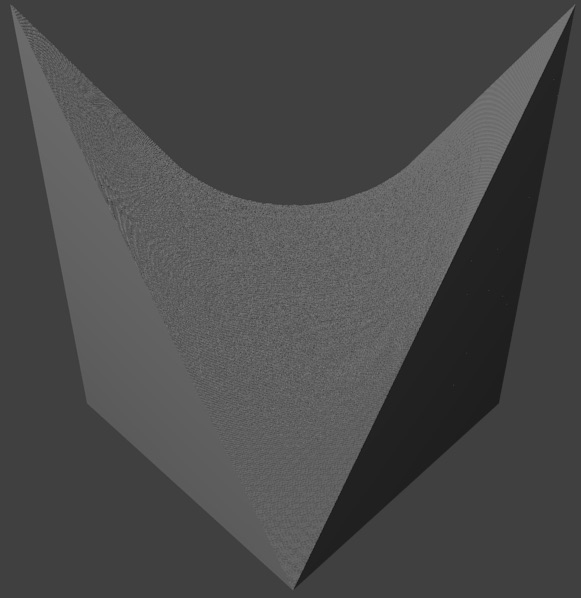
In homogenization, one does not pick a height function uniformly at random. Via a random field, certain heights will be preferred and other heights will be penalized. Mathematically, the height function is chosen according to the distribution of a Gibbs measure wrt. some Hamiltonian H. When doing so the limit shape changes. If the random field is unbounded one even sees the formation of terraces:
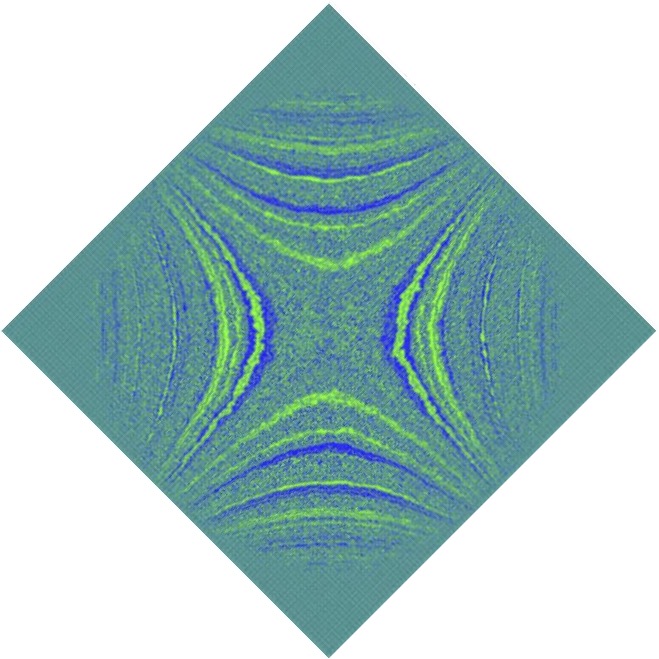
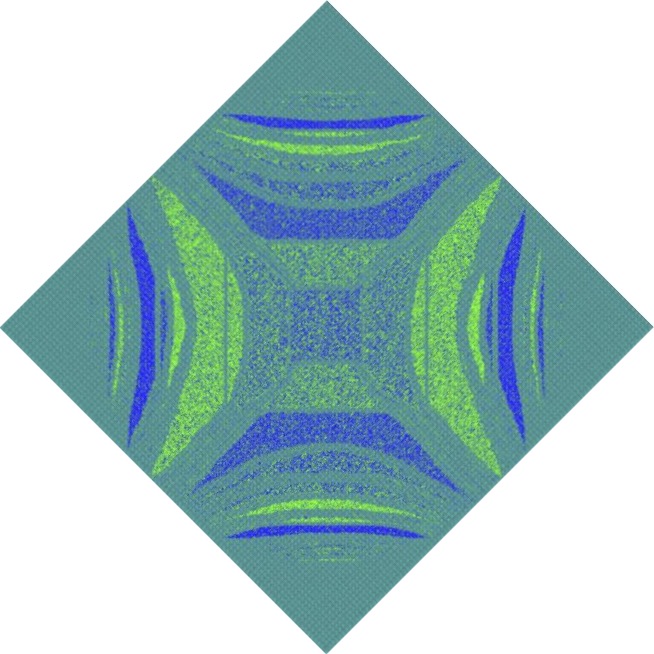
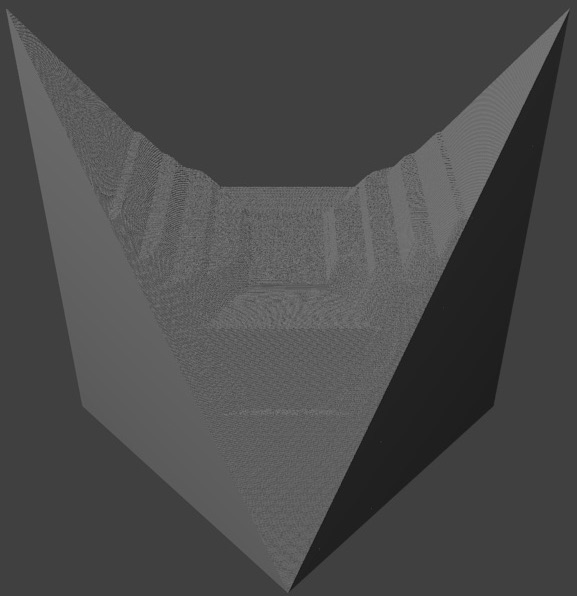
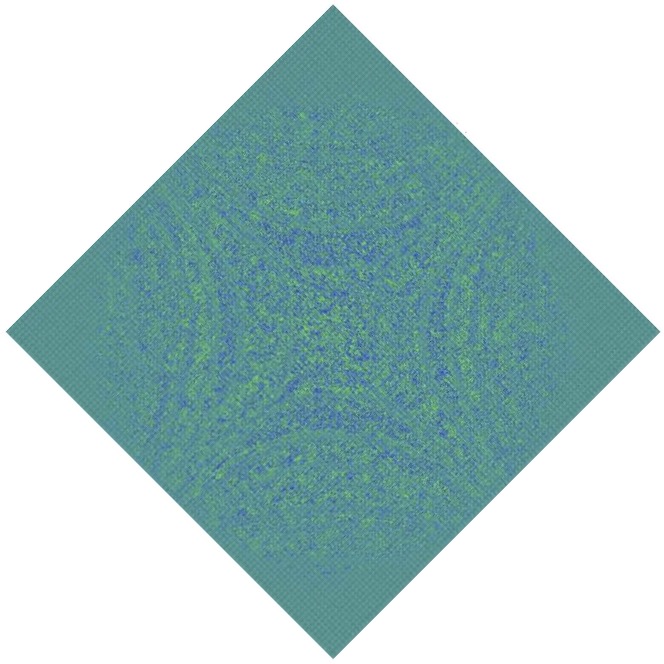
In the article we show that for bounded random fields a quenched variational principle holds with high probability. We also show that the continuous entropy functional homogenizes. This means that the continuous entropy functional does not depend on the specific realization of the random field. If a variational principle holds the continuous energy functional determines the limit shape seen in the simulations. Therefore, even when choosing different realizations of the random field one will see the same limit shape on large enough scales.
There are many more questions and problems we want to study:
-The first question is, if the limit shape is unique. For this one would have to show that the local surface tension is strictly convex.
-The second question is, if the arctic curve is universal. The arctic curve is the curve that divides the liquid region from the frozen region. In the simulations from above the arctic curve is a circle. The simulations suggest that the precise shape of the arctic curve should be independent of the precise statistics of the random field.
-The last question is to study the case of an unbounded random field. The simulation of a random field that is iid. normal distributed shows the appearance of terraces in the quenched limit shape. This suggest that the limiting model is not a gradient model i.e. the continuous entropy functional is not a function of the gradient of the continuous height function. However, it would be interesting to see if the annealed variational principle holds and if the annealed limiting model is a gradient model.
Further reading:
A quenched variational principle for discrete random maps, Andrew Krieger, Georg Menz, Martin Tassy, arXiv:1710.11330.
A variational principle for a non-integrable model, with Martin Tassy, arXiv:1610.08103.Talk: Variational principles for discrete maps, Oberwolfach December 2016 and at the Southern California Probability Symposium.